NICOSIA MEVLEVIHANE (CYPRUS TURKISH ETHNOGRAPHY MUSEUM)
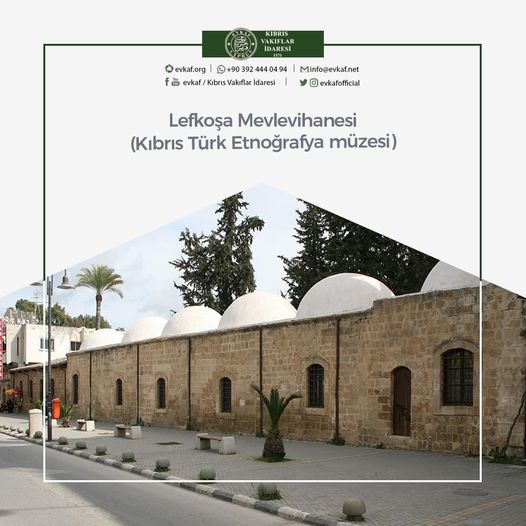
NICOSIA MEVLEVIHANE (CYPRUS TURKISH ETHNOGRAPHY MUSEUM)
NICOSIA MEVLEVIHANE (CYPRUS TURKISH ETHNOGRAPHY MUSEUM)
Arap Ahmet Pasha, who took part in the conquest of Cyprus, had the Nicosia Mevlevihane built in 1002 (1593) on his own land near the Girne Gate, within the framework of the foundation he established. One of the important neighborhoods of Nicosia and the mosque in this neighborhood, the first traditional style domed mosque built in Cyprus, are also named after Arabahmet Pasha.
The Mevlevihane, which was put into service about twenty years after the conquest, grew with the addition of the land donated by a lady named Emine Hatun and became a social complex with the characteristics of 16th century Turkish architecture.
The tomb of Arap Ahmet Pasha is in the mausoleum in the Mevlevihane; Emine Hatun's grave is in the garden of the Mevlevihane.
After the death of Sheikh Selim Dede in 1954, the life in the lodge, which lasted for centuries after the 16th century, gradually vanished into history. When the lodge lost its function after this date, it was used as a Turkish Nursery for a while. The Mevlevihane gained a new function on April 30, 1963 as the Cyprus Turkish Ethnography Museum.
After the restoration in 2001-2002, the exhibits were rearranged and the museum was reopened on 17 December 2002 with the Şeb-i Arus ceremony.